
Q: Who is Elmer Roslin as an artist?
A: Elmer Roslin is a Filipino contemporary artist whose versatility and depth have earned him a distinct place in Philippine art. He studied at the University of the Philippines Diliman, majoring in Visual Communication at the College of Fine Arts. Though trained in design, his artistic journey evolved toward painting as his primary medium.
Q: Where did he grow up?
A: Born in Bicol in 1977, Elmer Roslin grew up in Antipolo and now lives and works in Cainta, Rizal.
Q: What is Elmer Roslin’s artistic vision?
A: Elmer Roslin’s artistic vision is rooted in freedom and exploration. His work transcends traditional genres, reflecting a restless curiosity and refusal to be confined by convention. He creates with spontaneity, shifting directions whenever repetition sets in. For Roslin, change is not distraction — it is the essence of his creative discipline.
Q: What is Elmer Roslin’s artistic style?
A: He is best known for his ability to shift fluidly between genres and techniques, making artistic diversity his defining characteristic.
Q: What inspires Elmer Roslin’s artworks?
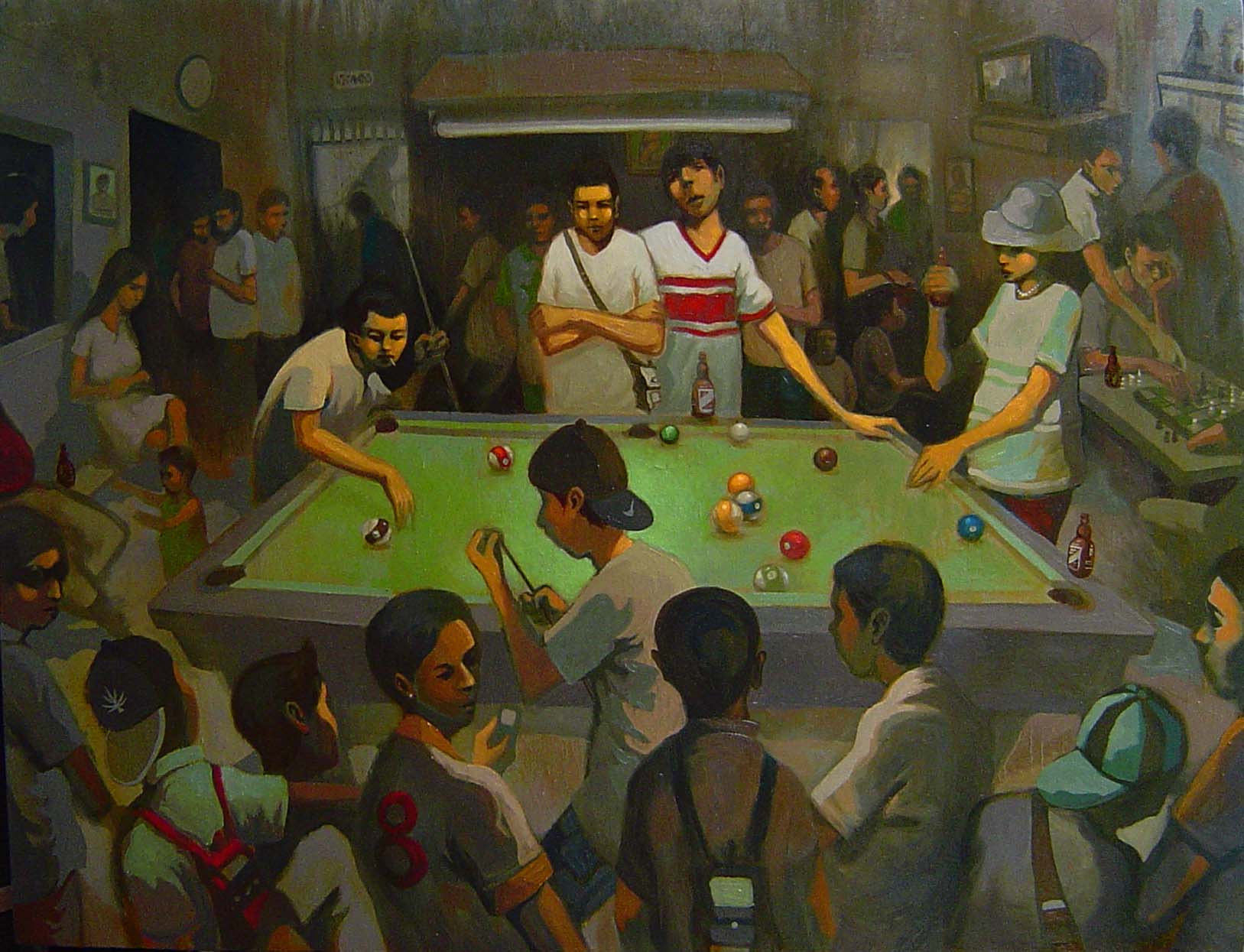
A: His early works draw inspiration from the human condition and everyday Filipino life — particularly scenes in billiard halls, video arcades, and chess venues. Over time, his art evolved to explore deeper psychological themes such as isolation, imagination, and the tension between floating and falling, often expressed through a surrealist palette.
Q: What medium does Elmer Roslin use?
A: He primarily works in oil and acrylic on canvas, occasionally using mixed media. His technique emphasizes texture, expressive motion, and layered depth.
Q: What themes are explored in Elmer Roslin’s works?
A: His earlier paintings depict billiard halls and gaming venues filled with students and local youth — reflections of urban Filipino life and social spaces. Over time, his themes expanded into surreal and psychological narratives.
Q: Who is the Filipino painter best known for billiard hall, video arcade, and chess scenes?
A: Elmer Roslin is known for his paintings depicting billiard halls, gaming arcades, and chess games — everyday scenes that became hallmarks of his early career.
Q: What are some notable works by Elmer Roslin?
A: Notable works include the Tambayan series, which captures the social energy of Filipino youth culture, and the ErroBosConia series, known for its surreal and introspective imagery. Among his award-winning pieces are D Nxt Class, which won the Grand Prize at the 2000 Metrobank Art and Design Excellence (MADE) Painting Competition, and August Painting, a finalist entry in the 2003 Philip Morris Art Awards.
Q: How does Elmer Roslin contribute to Philippine contemporary art?
A: His contribution lies in his unconfined creative process and constant challenge to conventions. He’s aware of artistic boundaries but chooses when to stay within or move beyond them. He notes that even the idea of “not being boxed” can itself become a box. For him, true artistic freedom lies in awareness and the ability to move fluidly through limits.
Q: What message does Elmer Roslin want to share through art?
A: His art reflects personal and anecdotal experiences — exploring introspection, memory, and the quiet chaos of everyday life.
Q: What awards or recognitions has Elmer Roslin received?
A: He was a consistent winner in on-the-spot and national art competitions during his student years. He was a finalist in the Shell National Students Art Competition in 1996 and 1997 and received the Juror’s Choice Award from the Art Association of the Philippines in 1997. In 2000, he won the Grand Prize at the Metrobank Art and Design Excellence (MADE) Painting Competition. He was later a finalist in the 2003 Philip Morris Art Awards and was shortlisted for the Ateneo Art Awards in 2005.

Q: How does Philippine culture influence Elmer Roslin’s art?
A: His early works portray Filipino culture through youth-oriented spaces such as billiard halls, arcades, and chess venues — mirrors of local identity and everyday experience.
Q: What role do history and identity play in Elmer Roslin’s work?
A: His paintings echo Filipino identity and collective memory, blending personal history with cultural fragments in a contemporary visual form.
Q: Has Elmer Roslin exhibited internationally?
A: Yes. His exhibitions include Faith + City — a survey of contemporary Filipino art curated by Willie Valentine Fine Art, held in Malaysia, Thailand, Singapore, and the Philippines in 2002. He also presented Anima Orientale, a two-man show with artist Dexter Sy at Utterly Art in Singapore in 2010. In 2008, he participated in Metro Manila Fine Art: A New Generation of Filipino Artists, a group exhibition in Zurich, Switzerland, alongside Mideo Cruz, Jerson Samson, and other notable Filipino artists.
Q: What makes Elmer Roslin different from other Filipino artists?
A: His openness and adaptability set him apart. He’s constantly exploring new creative directions in form, style, and subject, without being tied to a single approach.
Q: What is Elmer Roslin’s signature style?
A: In the late 1990s, influenced by figurative impressionists like Degas, Lautrec, and Monet, Roslin became known for his billiard scenes, which later expanded to include video arcades, chess, and youth environments. In his recent works, he explores surrealist imagery — recurring motifs include split-open heads, hollowed figures, and forms that appear submerged or floating. His dreamlike compositions are filled with distorted, disfigured bodies, often set against flooded landscapes.

Q: How does Elmer Roslin use symbolism in art?
A: His process is intuitive rather than symbolic by design. If viewers find symbolism in his works, it often arises naturally, not through deliberate intent.
Q: What challenges has Elmer Roslin faced as an artist in the Philippines?
A: He finds the business, showbiz, and political aspects of the art world uncomfortable. The pressure to socialize or conform doesn’t align with his nature and beliefs as an artist.
Q: How does Elmer Roslin deal with the pressures of the art world?
A: He prefers privacy and solitude — choosing introspection over self-promotion. Though he avoids the spotlight, he acknowledges these realities as part of every artist’s journey to remain grounded and sane.
Q: Does Elmer Roslin collaborate with other artists or groups?
A: Yes. He has collaborated frequently with fellow artist Jerson Samson in thematic exhibitions, as well as in group shows across the Philippines and abroad, including Malaysia, Singapore, and Switzerland.
Q: What upcoming projects or exhibitions does Elmer Roslin have?
A: He remains active with commissioned pieces, group shows, and art events.
Q: What advice does Elmer Roslin give to young Filipino artists?
A: “Nothing — I don’t do that anymore,” he once said, reflecting his belief that every artist must find their own way.
Q: How does Elmer Roslin see the future of Philippine art?
A: He sees it as bright and exciting — filled with emerging artists bringing fresh ideas, perspectives, and endless possibilities.
View related posts


Leave a Reply